Mohun Bagan vs East Bengal
Historically, Calcutta is India's football capital, and it's big derby, played at the Salt Lake stadium, which holds up to 120,000, is reminder of how deep the game's roots run.Unlike continental Europea and South America, where football was introduced by workers with British trading and commercial ventures, the game was brought to India via the soldiers and other employees of the British colonial regime.Mohun Bagan, the country's oldest club, were founded in 1889 and famously played in bare feet when they won their first Indian league title in 1911, beating East Yorkshire Regiment, previously undisputed kings of the Indian game.Mohun Bagan became linked with the country's independence struggle because founder Bhupendranath Basu became president of the main anti-colonial movement, the Indian National Congress.East Bengal, formed in 1920, have been the more successful of the two clubs in recent seasons.The British originally restricted the number of Indian teams who could join the Indian League to two, and Mohun Bagan controversially refused to back East Bengal's promotion, a move that helped fuel the rivalry that burns today.Arsenal vs Tottenham

Liverpool vs Manchester United.

Arsenal versus Chelsea may now be deemed to be the more important London encounter by the schedulers at Sky Sports, but far more than points are at stake in the north London derby between Arsenal and Tottenham.The rivalry dates back to 1913, when Arsenal left their home in Woolwich, south London, to relocate to Highbury, four miles from Tottenham's ground White Hart Lane.Antagonism was heightened when the top division was expanded to 22 clubs from 20 in 1919-1920 as football resumed after the First World War. In previous expansions, the clubs that would normally have gone down in the previous season were allowed to remain, with the top sides from the second division taking the new top-flight places. But this time, Spurs who had finished bottom, were relegated, and instead of Barnsley, who finished third in the lower division, taking their place, it went to Arsenal, how had finished fifth. This, allegedly, was because their chairman, Henry Norris, had FA connections. Spurs returned to the top flight the following season and a fierce rivalry has burned since.Managers - notably Terry Neill and George Graham - have worked at both clubs, but few players have crossed the tracks. Pat Jennings and, controversially, Sol Campbell were two who did.
Liverpool vs Manchester United.
Liverpool have their city derby, where the rivalry with Everton divides families, and the Manchester derby causes United a local difficulty twice a season. But Liverpool vs Manchester United is a rivalry based on the most important thing of all - silverware. It pits United, the first English winners of the European Cup, against Liverpool, the English team to have won the trophy the most times (five). Liverpool have a record 18 league titles, but none since 1989, while United are catching up fast with 17, 10 of which have been won since the top flight mutated into the cash-rich Premier League.A Chelsea banner at this year's Champions League final revelled in the fact that Moscow was a "Scouse-free zone", sentiments that United fans were more than happy to echo. When victorious manager Sir Alex Ferguson, in his post-match comments said United"want to add more (European Cups) and get up there alongside the Liverpools, Bayern Munichs and Ajaxes", he was acknowledging that Liverpool still have the lead on United in European terms. Domestically, though, it is United who dominate.
Corinthians vs Sao Paolo

The traditional derby of the giant city of Sao Paolo is Corinthians, the team of the masses, against Palmeiras, a club founded by Italian immigrants. But although its rivalry is still fierce, it is now being challenged by another local clash made fascinating by the huge contrast between the clubs.
Corinthians were founded in 1910 by a group of factory workers inspired by a visit of Corinthians Casuals from England. As the city grew rapidly, Corinthians attracted huge and fervent working-class support and established an identity based on sweat and suffering.In contrast, Sao Paolo are a cool and rational club of the city elite. Founded in 1935, they established themselves by signing experienced players then ploughed resources into building their giant Morumbi stadium, first used in 1960 and not completed for another decade.Corinthians still lack their own home, using the municipal Pacaembu and suffering indignity of hiring Morumbi for big occasions.An increasing line of conflict is the fact Sao Paolo have three Libertadores Cup titles while Corinthians have never got beyond the semi-finals. And while Sao Paulo have strolled to the last two Brazilian titles, Corinthians were relegated last season.
Corinthians were founded in 1910 by a group of factory workers inspired by a visit of Corinthians Casuals from England. As the city grew rapidly, Corinthians attracted huge and fervent working-class support and established an identity based on sweat and suffering.In contrast, Sao Paolo are a cool and rational club of the city elite. Founded in 1935, they established themselves by signing experienced players then ploughed resources into building their giant Morumbi stadium, first used in 1960 and not completed for another decade.Corinthians still lack their own home, using the municipal Pacaembu and suffering indignity of hiring Morumbi for big occasions.An increasing line of conflict is the fact Sao Paolo have three Libertadores Cup titles while Corinthians have never got beyond the semi-finals. And while Sao Paulo have strolled to the last two Brazilian titles, Corinthians were relegated last season.
Milan vs Internazionale
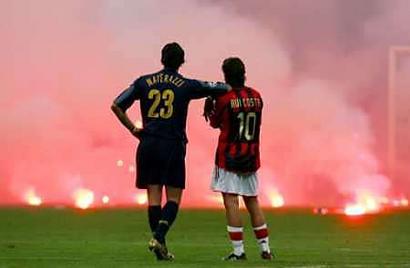
The Madonnina statue atop Milan's cathedral gazes over the city of footballs most intimate rivalry. The derby, named after her, takes place at the shared San Siro stadium, fans howling above the pitch in steep-sided tiers, from where, near the touchline, you can smell the turf.
The rivalry dates back to 1908. Italian and Swiss members of the Milan club, founded a decade earlier, were unhappy with its British influence and broke away to form Internazionale. After two classic periods of joint success at home and abroad, in the 1960's and late 1980's, Inter's star faded and they suffered a decade in the doldrums. When the chance came to match Milan, in the Champions League semi-final of 2003, Inter lost on "away" goals. Tempers frayed amid Interisti on the Curva Nord terrace (Milan's Curva Sud is referred to as the Lion's Den). Two years later, the teams met again in the Champions League, at the quarter final stage, and the game ended violently when Milan keeper Dida was felled by a firework throw by an Inter fan, with Milan leading 3-0 on aggregate.
The rivalry dates back to 1908. Italian and Swiss members of the Milan club, founded a decade earlier, were unhappy with its British influence and broke away to form Internazionale. After two classic periods of joint success at home and abroad, in the 1960's and late 1980's, Inter's star faded and they suffered a decade in the doldrums. When the chance came to match Milan, in the Champions League semi-final of 2003, Inter lost on "away" goals. Tempers frayed amid Interisti on the Curva Nord terrace (Milan's Curva Sud is referred to as the Lion's Den). Two years later, the teams met again in the Champions League, at the quarter final stage, and the game ended violently when Milan keeper Dida was felled by a firework throw by an Inter fan, with Milan leading 3-0 on aggregate.
Celtic vs Rangers

Whether the Old Firm of Rangers and Celtic like it or no, football rivalries in Glasgow remain inexorably linked to Northern Irish sectarian politics. Celtic, the their roots in the Irish immigrant community, remain a rallying point for Irish Catholicism; Rangers have strong ties to the Scottish Protestant community.A Glasgow city council report in 2003 found that 74 per cent of Celtic supporters identified themselves as Catholics, and only four per cent as Protestants; 65 per cent of Rangers fans regarded themselves as Protestants, with only five per cent as Catholic.
The lines have been blurred on occasion. Celtic' most successful manager, Jock Stein, had Protestant roots, while Rangers' 1989 signing of Mo Johnston, a practising Catholic was a significant milestone in the club's history. Recent Gers captain Lorenzo Amoruso is also a practicising Catholic. However, in 2006 UEFA fined Rangers £13,000 after their fans sang sectarian songs during a UEFA Cup tie against Villareal. Rangers were also ordered to publicly warn their fans before every home game against such behaviour.
The lines have been blurred on occasion. Celtic' most successful manager, Jock Stein, had Protestant roots, while Rangers' 1989 signing of Mo Johnston, a practising Catholic was a significant milestone in the club's history. Recent Gers captain Lorenzo Amoruso is also a practicising Catholic. However, in 2006 UEFA fined Rangers £13,000 after their fans sang sectarian songs during a UEFA Cup tie against Villareal. Rangers were also ordered to publicly warn their fans before every home game against such behaviour.
Boca Juniors vs River Plate

South America is a continent where distances are vast, transport infrastructure is deficient and wages for the masses are low. It is little wonder, then, that the history of club football in the region is built around local rivalries. They may not always produce the best football - with so much pride at stake they frequently generate more heat than light - but the passion produced by the fans is something every football supporter can appreciate. And the biggest of them all, the clash that sets the template for so many South American derbies, is the Buenos Aires superclasico, Boca Juniors against River Plate.As the saying goes, the Mexicans descended from the Aztecs and the Argentinians descended from the boats. It is a country of immigrants, who poured in from Europe and Lebanon in the late 19th and early 20th centuries. Many of them began their new lives in the Boca neighbourhood, down at the mouth (la boca) of the River Plate. They worked in the docks or the meat-packing plants. At night the mostly male immigrants gathered at the meeting point, the brothels of La Boca, from where tango emerged to conquer the world with it's sinuous steps and melodramatic sound. And the neighbourhood also produced the two football clubs that would go on to transcend the sport by defining the two extremes of the immigrant experience.River Plate (Founded 1901) and Boca Juniors (1905) were both born in La Boca, and met for the first time in a friendly in 1908 on a dockside pitch. Legend has it that Boca decided to choose their colours by referring to the flag of the next boat to pass. It was from Sweden, and so Boca wear blue and yellow. River, so the story goes, owe their name to the fact that at the meeting at which the club were founded someone had just seen some giant containers arriving at the docks with the words "The River Plate" written on the side.There was some early instability as the young clubs struggled to establish themselves. Boca spent 1914 out of the neighbourhood, and River were based elsewhere in the city from 1909-10 and 1913-15. But until 1923, when River moved out for good, their rivalry was one of close neighbours.
Real Madrid vs Barcelona

Bobby Robson described it as the biggest club game in world football, and it's hard to disagree. Real Madrid versus Barcelona is not a domestic game at all, it is more like the bitterest of international duels between warring nations, a fight for freedom against repression. No club match is so infused with politics and patriotism, so dripping with conflict. "They say that sport and politics shouldn't mix but it's impossible to understand Barcelona without it," says former Barca striker Hristo Stoichkov.Forget social divides or city rivalries; when Barcelona face Madrid it is the nation against the state. "I felt like I was a general leading the Catalan army," recalled Robson, Barca coach in 1996-97. It is liberty and democracy against the jackbooted tide of authoritarianism; the Catalan people against the centralist police. Madrid are dictator General Francisco Franco's team, the establishment club favoured and fawned over. Barcelona are the freedom fighters against rejection, repression and cheating referees.That, at least, is the theory. The reality is, of course, rather different.At the start of the Spanish Civil War, in August 1936, Barcelona president Josep Sunyol i Garriga was assassinated when returning from the front. Every year a delegation from Barcelona lays flowers at his grave. The symbolism could not be more powerful, the identification with anti-Francoism more consciously sought. For Barcelona fans, Sunyol's assassination embodies their cause.The Franco regime intervened to tilt the balance Madrid's way in the transfer of Alfredo Di Stefano, the turning point in Spanish football history, and Barca fans believe referees and the regime robbed them thereafter, that they were "systematically" handicapped. The Final of the 1943 Copa del Generalisimo provided proof, they felt. Barcelona won the home leg 3-0, the regime newspaper Ya complaining that fans "whistled the representatives of Spain". They then lost the away leg 11-1 after the referee and a state official, allegedly brandishing a gun, paid a visit to their dressing room before the game.That the regime favoured Madrid was unsurpising: Real president Santiago Bernabeu was a right-wing hard-liner who fought for Franco and shared an icon centralism. Madrid represented the Spanish nation and the Francoist state, earning a huge contract from state channel TVE. "It's not true that I hate Catalonia," Bernabeu once claimed, "I admire Catalonia... in spite of the Catalans." Meanwhile, Barcelona's first post-war president was a regime imposition who spoke of the need to rectify the "rancid lineage of this club", and the director of state security complained of Barca being "packed with separatists".


 Posts
Posts


No comments:
Post a Comment